
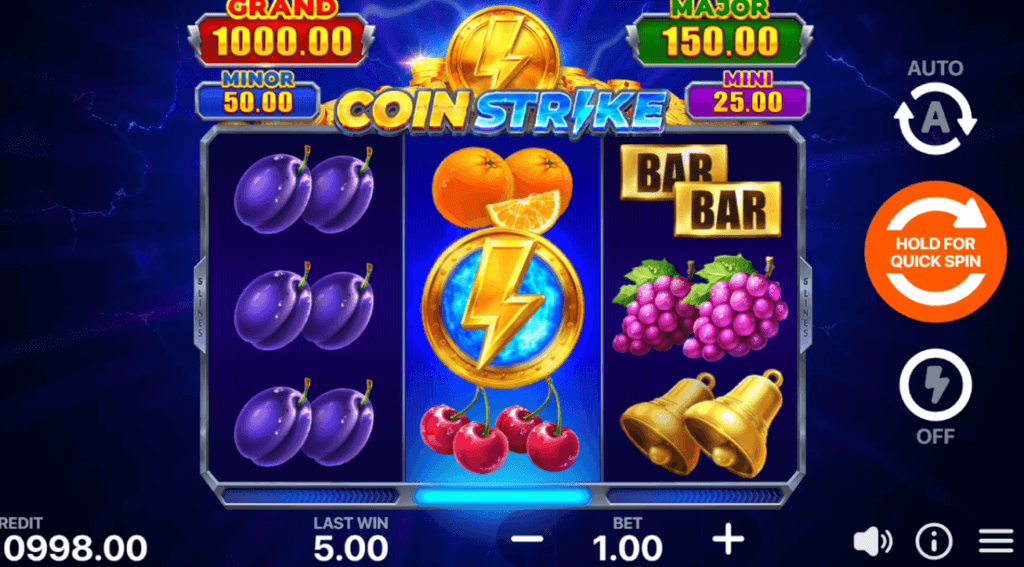
Coin Strike Hold and Win Slot is a five-reel three-row slot that uses a fixed set of 25 paylines to assess every spin. The game is built around a mining theme where gold coins, pickaxes and lanterns occupy the reels, and the Hold and Win mechanic lies at the centre of its appeal. Players place bets between 0.25 and 125 credits per spin, and the maximum advertised win is 5,000 times the stake. The published return-to-player figure is 96.10 percent, while the volatility sits in the medium-to-high range, meaning wins occur at a moderate pace but can fluctuate significantly in size. Understanding how the Bonus Buy feature works lets you decide when paying an upfront premium is worth the cost. The mining visuals go beyond the reels themselves: the background shows a dimly lit tunnel with wooden support beams and flickering lanterns that illuminate whenever a coin lands. Sound design reinforces the theme with the clink of metal on rock and the occasional rumble of distant machinery. These details form an immersive loop that holds focus on the grid even during longer sequences of base-game spins.
What a Bonus Buy Feature Really Does
The Purchase Bonus option in Coin Strike Hold and Win Slot enables you to pay a set multiplier of your current stake to activate the Hold and Win bonus round immediately. As opposed to waiting for three or more bonus symbols to show up organically, you pick the buy button, verify the shown price, and the reels turn once before the feature begins. The cost is shown in credits so you can contrast it with your available balance before deciding. Since the feature is unable to be triggered twice in a row from the base game, the buy option provides the only guaranteed route into the round during a individual session. This mechanic shifts the risk profile: you trade a defined upfront cost for a greater average return, but you yet face the same random outcomes once inside the bonus. The solitary teaser spin that comes after the purchase is not purely decorative; it determines the starting positions of any initial coins that will secure in place when the Hold and Win grid shows up. Although the outcome remains random, observing those first coins land can provide an early feeling of whether the purchased round begins with momentum or needs several respins to generate value.
Complete Guide to Employing Bonus Buy
First, launch Coin Strike Hold and Win Slot on a UK-licensed platform and load the game in your app. Modify the stake buttons until the desired bet size is displayed in the bet panel. Identify the tiny coin-shaped button named “Buy Bonus” positioned beside the spin button. Tap the icon to bring up a confirmation window that shows the precise credit fee and the anticipated RTP for the bought round. Examine your remaining balance to verify you can cover the transaction without falling below the minimum allowed bet. Hit the buy key once again, view the one teaser turn, and the Hold and Win screen will appear automatically. The entire procedure lasts less than ten seconds from press to feature beginning. Some sites include an further confirmation stage that demands you to check a checkbox acknowledging the price before the buy completes. This extra click exists to avoid accidental buys and is disabled in the settings section if you find it slows the flow. Once the screen loads, the initial three respins commence right away, so there is zero additional wait between purchase and the beginning of play.
Typical Pitfalls to Avoid
One frequent error is viewing the Bonus Buy as a different game mode instead of a shortcut into the current Hold and Win round. The reels, coin values and jackpot rules remain identical whether you buy or trigger naturally, so no new strategies turn available. Another mistake is increasing the stake solely to boost the buy price in the hope of larger jackpots. While jackpots do adjust with the bet, the proportional cost grows at the same rate, keeping the same RTP. Finally, some players exhaust their entire balance on repeated buys after a short losing streak. Because each purchase is independent, a run of low-value outcomes can appear just as easily after buying as after natural triggers, so it is wise to set a strict limit on consecutive buys before reverting to regular play. A less obvious error involves neglecting the minimum bet requirement after a purchase. If the buy cost leaves exactly the minimum stake remaining, any further base-game spins become unavailable until the balance grows again. Maintaining at least one full buy price plus the minimum stake in reserve avoids this situation and maintains flexibility throughout the session.
Evaluating Natural Triggers and Bonus Buy
Natural entry into the Hold and Win feature depends on landing at least three bonus symbols on any spin. With twenty-five paylines active, the theoretical hit rate stands at 0.56 percent, or roughly once every 180 spins at average speed. Bonus Buy eliminates this wait but charges sixty times the stake for the privilege. If your main goal is fun and you enjoy the base-game cycle, natural triggers protect more of your bankroll for additional spins. If your goal is to experience the bonus round within a limited timeframe, the buy option delivers certainty at a known cost. Neither method alters the random number generator, so long-term results still approach the stated RTP percentages. The base-game cycle also contains its own smaller features, such as random coin drops that award instant credits without entering the full Hold and Win round. These micro-events add texture to extended sessions and can balance some of the cost difference between natural and purchased entries. Players who appreciate these incidental wins may therefore choose natural triggers even when time is limited.
Price versus Expected Return
The Bonus Buy fee is set at 60 multiplied by your current stake. At the minimum bet of 0.25 credits the cost equals 15 credits, while the maximum bet of 125 credits raises the price to 7,500 credits. The stated return-to-player number for the bought round is 96.80 percent, somewhat higher than the base-game figure of 96.10 percent. This discrepancy exists because the buy option excludes the chance of spins that generate no bonus entry at all. However, the higher RTP does not guarantee a profit; it simply lowers the house edge by a small margin. You should compare the shown cost against your session budget and choose whether the increased chance of a large payout warrants the immediate deduction. At the 60-credit price point, the expected value calculation indicates that roughly 58.08 credits go back to the player over the long run, resulting in a house edge of 1.92 credits per purchase. This margin is narrower than the base-game edge, yet it still signifies a cost that must be considered against the entertainment value of immediate access to the feature. Players who monitor results over hundreds of buys can observe whether their personal outcomes align with or diverge from these official percentages.
When the Purchase Option Is Logical
Gamers with a set playtime or a clear goal frequently opt for the purchase feature as it eliminates doubt about when the bonus will trigger. When you plan to play for merely thirty minutes, waiting for three bonus icons to hit naturally could leave scant time for the actual feature. Spending the extra cost guarantees the feature begins immediately, allowing you to assess its result within your allotted time. Conversely, if your balance comfortably covers several hundred spins, the natural trigger rate of roughly one in 180 spins may deliver enough bonus entries without the extra cost. The decision therefore hinges on time constraints and bankroll size rather than any inherent superiority of one method over the other. Another situation where buying becomes attractive is when a site offers a temporary promotion that refunds a percentage of the buy price if the round produces below a certain threshold. In such cases the effective cost drops, shifting the risk-reward balance in favour of the purchase. Users who see these promotions can configure alerts or review the offers page before launching the game so they do not miss the chance.
How the Hold and Win Bonus Works
Throughout the Hold and Win feature the reels transform into a six-by-four grid where only special coin symbols or blanks are possible. Each coin bears a credit value or a jackpot label, with any landed coin remaining locked in place while the rest of the positions respin. You start with three respins, and any new coin returns the counter to three. The round ends when no new coins land or when all fifteen positions are filled. If the grid becomes full you gather all shown values plus the grand jackpot. The feature therefore rewards patience: the longer coins keep appearing, the more positions fill and the higher the total payout climbs. The six-by-four layout creates fifteen individual cells, each capable of holding one coin. Since the grid is bigger than the base-game reels, the visual density grows and every fresh coin instantly alters the displayed sum. A small panel above the grid displays the respin counter, counting down visibly so you can track exactly how many attempts remain before the round concludes.
Jackpot amounts and their awarding method
Four jackpot categories are placed above the normal coin values. The mini and minor jackpots represent fixed amounts based on your stake, while the major and grand jackpots grow with the stake and are awarded only when their specific symbols land and the grid reaches full capacity. Because the grand jackpot requires every cell to contain a coin, it is the rarest event yet delivers the 5,000 times stake cap shown on the paytable. Those who buy the feature are subject to the same jackpot rules, so the potential top prize does not change; only the chance of entering the round itself is modified. The mini jackpot usually amounts to 15 times the bet and is found on coins with a bronze border, whereas the minor is 50 times the stake with a silver border. The major and grand use gold and diamond borders respectively, with amounts that adjust instantly as the bet changes. Only the grand demands a fully occupied grid; the other three can be claimed even if vacant cells are left when the round ends.
Bankroll Planning for the Buy Option
Before using Bonus Buy, Coin Strike Hold and Win Slot, estimate how many purchases your current balance can support. Partition the current credits by the displayed buy price to get the greatest number of entries. For example, with a 1,000-credit balance and a 60-credit buy cost, you can cover sixteen purchases before the balance falls below the minimum bet. Deduct an additional buffer of at least fifty credits to permit for any base-game spins you may wish to place between buys. This simple division prevents the common situation where a player has enough for one more buy but not enough to fulfill the stake requirement afterward. Maintaining a written note of the resulting figure helps preserve discipline during a session. A more detailed approach entails tracking the actual outcomes of each purchased round in a small spreadsheet or notebook. Logging the credit cost, the number of coins collected, and the final payout lets you to compute a personal RTP over time. If the running figure drops noticeably below the published 96.80 percent, it may be worth lowering the frequency of buys or changing back to natural triggers until results stabilize.
Closing Thoughts on Choosing the Best Approach
Coin Strike Hold and Win Slot compensates players who match their entry method to their personal constraints rather than pursuing perceived advantages. If time is short or you want direct access to the Hold and Win grid, the Bonus Buy feature delivers exactly that at a transparent cost. If your balance enables extended play and you opt to let the reels decide when the bonus appears, staying with natural triggers maintains the session length longer and the cost per feature lower on average. Whichever route you pick, load the game on a UK-licensed site, check the current buy price against your balance, and set a firm limit on consecutive purchases before you begin. This single habit transforms the Bonus Buy from an impulsive click into a deliberate part of your overall playing plan. Over multiple sessions the most consistent results come from treating each purchase as one planned element within a larger budget rather than an isolated decision made in the moment.